


Gilyonos for Shabbos to Download
|

|
Advert |
 |
|
|
| Jewish News |
| Leading Rabbanim Meet President Trump |
   |
|
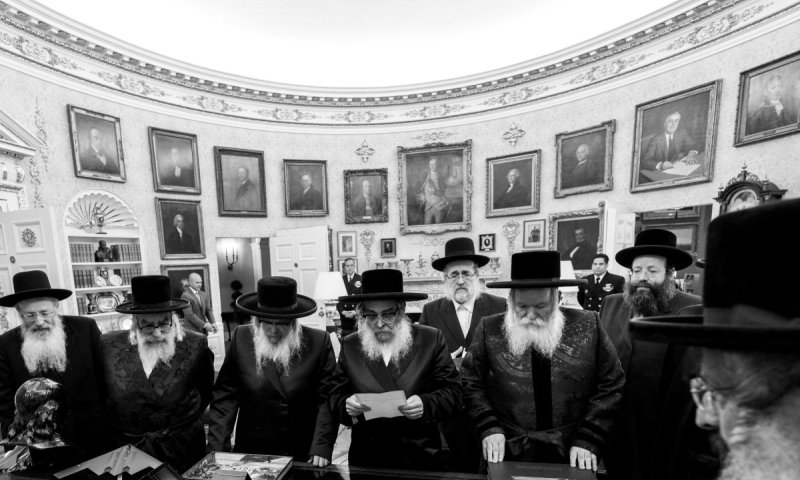
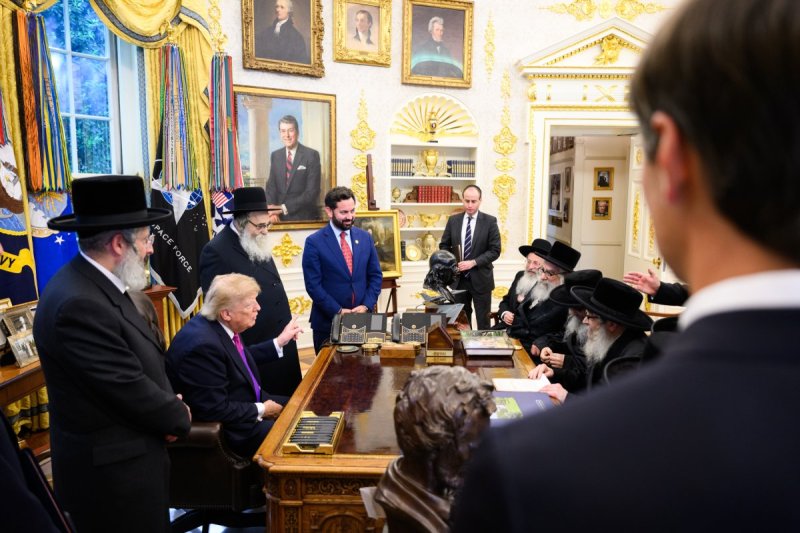
In an extraordinary and historic gathering, a distinguished delegation of leading Rabbanim and community representatives visited the White House in Washington, D.C., for a rare meeting with President Donald Trump and senior members of his administration. The delegation included the Satmar Rebbes, the Bobov Rebbe, Rav Malkiel Kotler, Rosh Yeshiva of Beth Medrash Govoha in Lakewood, and Rav Aharon Menachem Mendel Twersky, son of the Skverer Rebbe. Congressman Mike Lawler, who played an important role in facilitating the historic visit, was also present. The gathering opened with remarks from Reb Yoel Rosenfeld, a prominent Bobov community representative, who introduced several of the major issues facing Orthodox Jewish communities. Among those who addressed the meeting were the Satmar Rebbe, Reb Gedalia Segedin, Kiryas Joel Mayor Israel Moshe Spitzer, Reb Moshe Dovid Niederman, Reb Yehuda Leib Zorger, and Reb Moshe Margareten. The discussions focused on a broad range of concerns affecting Orthodox Jewish communities, particularly those in New York and New Jersey, and on areas where the federal government could provide assistance. Reb Gedalia Segedin specifically presented the needs of the more than 50,000 residents of Kiryas Joel, outlining several issues of importance to the rapidly growing community and explaining where assistance from the administration could make a significant difference. During the meeting, Vice President J.D. Vance entered the room and warmly greeted the Rabbanim and community representatives. He spent time speaking with members of the delegation and discussing several matters currently facing the community. A particularly significant moment came when the Satmar Rebbe was invited, together with Reb Gedalia Segedin, to meet privately with President Trump. The approximately 15-minute private meeting centered largely on efforts involving the release of captives and other urgent matters. The Rebbe warmly blessed the president and spoke with him directly about the issues that had brought the delegation to Washington. President Trump listened closely and discussed the matters with the Rebbe in detail. Following the private conversation, the remainder of the delegation was invited into the Oval Office for a full meeting with the president. The Satmar Rebbe, who was already inside, waited as the other Rabbanim and representatives personally greeted President Trump. The delegation then took their seats around the table, with the Rebbe seated directly across from the president. In one of the most memorable moments of the visit, the Satmar Rebbe rose from his seat, followed by all the Rabbanim gathered around the table, and recited the traditional prayer for the welfare of the government and its leaders. Reb Gedalia Segedin was then asked to translate the prayer into English for the president. President Trump was visibly moved by the moment. He immediately requested that his son-in-law Jared Kushner be called into the room, saying that Kushner needed to be present while such distinguished guests were visiting the White House. Afterward, the Rebbe addressed the president and warmly thanked him for actions he had taken on behalf of religious communities. He specifically expressed appreciation for the steps taken during the COVID period that allowed houses of worship and religious institutions to reopen. The conversation then continued into a number of issues of major concern to Orthodox Jewish communities in the United States and beyond. The other Satmar Rebbe expressed his appreciation to President Trump for what he described as the president’s strong support for the Jewish people and for Jews facing difficulties around the world. He also raised the highly sensitive issue of the military draft affecting yeshiva students in Israel, bringing the matter directly to the president’s attention. Rav Aharon Menachem Mendel Twersky, son of the Skverer Rebbe, then addressed President Trump for several minutes and presented him with a personal letter from his father. The president showed particular interest in the Skverer Rebbe and asked about his well-being. The conversation continued with the delegation discussing additional matters affecting Orthodox Jewish life both in the United States and overseas. At one point, the Satmar Rebbe invited Rav Malkiel Kotler, Rosh Yeshiva of Beth Medrash Govoha in Lakewood, to address the president. Rav Kotler instead chose to present President Trump with a private letter concerning several important matters. Another unusual moment occurred when President Trump asked the Satmar Rebbe for the handwritten note on which the Rebbe had recorded the points discussed during their earlier private meeting. The Rebbe handed the paper to the president, who placed it inside his personal desk drawer — a gesture that members of the delegation viewed as reflecting the seriousness with which the president regarded the discussion. The Oval Office meeting continued for approximately half an hour, with President Trump and the delegation maintaining a warm and substantive conversation throughout. At the conclusion, the Rabbanim and community representatives thanked the president for the unusually warm reception and for taking the time to hear their concerns personally. As the delegation departed, the Rebbes and Rabbanim exchanged heartfelt blessings for the approaching new year, bringing an extraordinary White House visit to a close — one that placed some of the most pressing concerns of Orthodox Jewish communities directly before the highest levels of the United States government. |
|
|
|
Advert KOL HAMISHPAT PUBLICATION |
 |
|
|
| World News |
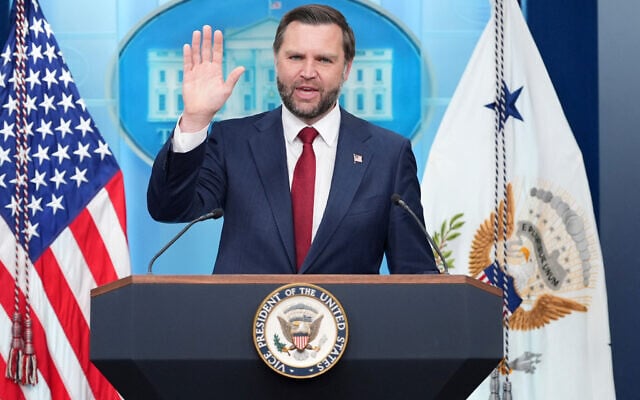
| Vance: Washington will only resume talks with Iran when it stops targeting ships in Hormuz |
 |
|
US Vice President JD Vance says Washington will only return to negotiations with Iran if Tehran stops targeting commercial ships in the Strait of Hormuz. “We are not talking to the Iranians, and we are not going to talk to them unless they stop shooting at commercial shipping,” Vance says during a press briefing. “My advice to the Iranians is stop acting like crazy people.” US President Donald Trump has recently suggested that he is not interested in negotiating with Iran under any circumstances, so Vance’s remarks indicated a bit more flexibility on behalf of the administration. Asked whether the Iran war will be over by the November 3 midterms, Vance responds, “I wouldn’t call it a war,” before indicating that the conflict timeline will depend on whether Iran allows traffic in the Strait of Hormuz to flow freely. Vance claims that the flow of oil in the strait is getting closer to prewar levels and that 15 million barrels came out of the channel last night. “The reason gas prices are so high right now is because the Iranians are shooting at commercial shipping… Yes, gas prices are higher in the United States, but they’re way worse everywhere else in the world,” he says, touting the Trump administration’s energy policy. On the deadly US strike earlier this week that reportedly hit a wedding in southern Iran, Vance confirms that CENTCOM is probing the matter. while expressing skepticism over Iranian state media’s information on the incident. |
|
|
|
Advert Install your Noam Machine today |
||
 |
||
|
|
| Israel News |
| Israeli High Court Unanimously Strikes Down Law Freezing Arrests of Chareidi Bnei Yeshivos |
 |
|
Israel’s High Court of Justice on Thursday unanimously struck down legislation that had frozen arrests and other enforcement measures against Chareidi bnei yeshivos who failed to report for military service, dealing another major blow to efforts to protect lomdei Torah from arrest amid the ongoing draft crisis. All nine justices on the expanded panel agreed that a fundamental defect in the legislative process required the law to be invalidated. Eight of the nine went further, ruling that the measure was also unconstitutional because it severely violated the constitutional principle of equality. The ruling came in response to five petitions challenging the validity of the legislation, including one submitted by the Israel Hofsheet organization. Deputy Supreme Court President Noam Sohlberg authored the principal opinion. The other members of the nine-justice panel were Daphne Barak-Erez, David Mintz, Yael Willner, Ofer Grosskopf, Alex Stein, Gila Canfy-Steinitz, Yechiel Kasher and Ruth Ronnen. The court unanimously concluded that the amendment ultimately approved by the Knesset departed substantially from the subject matter of the original bill that had passed its first reading. According to the justices, that violated Section 85 of the Knesset Rules of Procedure. Because the final measure differed so significantly from what had initially cleared the Knesset, the court determined that, for legal purposes, it was effectively legislation that had never passed a first reading. The justices characterized the procedural flaw as fundamental and sufficient on its own to require the law’s cancellation. |
|
|
 |
|
|
| IDF says it has finished clearing out Hezbollah’s Ali Taher Ridge facility ahead of demolition |
 |
|
The IDF announces that it has completed clearing out Hezbollah’s underground facility beneath the Ali Taher Ridge in southern Lebanon, ahead of its demolition. In a statement, the military says that in the past few weeks, troops of the 36th Division, after achieving “operational control of the ridge area above and below ground,” cleared two tunnel routes of Hezbollah operatives, killing some of them while others fled. The IDF describes the facility as a “strategic infrastructure that was built over two decades,” which it says was financed and planned by Iran. Inside the tunnels, the troops found “command centers, weapons rooms, generator rooms, living quarters, showers, and a kitchen,” which the IDF says enabled Hezbollah operatives “to conduct fighting and remain there for extended periods.” The IDF says that now that the underground site has been cleared of Hezbollah operatives, it is working to demolish it. “Upon completion of the activity, the IDF will establish a renewed defensive posture in accordance with the situational assessment,” the military says, indicating that it plans to withdraw from the area. The military says that Hezbollah operatives launched attacks from the underground site at the ridge. “Following the activity in the [tunnel] routes in recent weeks, the ability to carry out terror attacks against Israeli civilians and IDF troops from the routes has been neutralized,” the statement adds. Contrary to a report by Reuters earlier today, which said that a dozen members of the Islamic Revolutionary Guards Corps, including at least two senior officers, were with Hezbollah operatives at the underground site beneath the ridge, the Israeli military says it has cleared the tunnel routes of all terror operatives. There is also no indication that IRGC members were inside the tunnels when the IDF captured them. The earlier Reuters report also falsely claimed that the IDF had “put off storming” Ali Taher, despite the military being inside the tunnels for several weeks.2 |
|
|
| Israel said set to return 5 prisoners to Lebanon today as a ‘goodwill gesture’ |
 |
|
Israel is reportedly set to return five Lebanese prisoners to Lebanon today as a result of ongoing US-brokered talks between Jerusalem and Beirut. The move is considered a “goodwill gesture” by Israel amid the ongoing negotiations aimed at ending the conflict between Israel and the Hezbollah terror group. The next round of talks is scheduled for later this month in Rome. An official said that Israel and Lebanon were holding side negotiations on the identification and return of remains of Lebanese and Israeli Jews in exchange for Lebanese detainees. The Saudi Al-Hadath news outlet reports that one of the citizens slated to be returned by Israel to Lebanon today is named as Malek Kamal Razi. The report says the exchange is slated to take place through the Naqoura Crossing along the Israel-Lebanon border. The purported move comes two days after Prime Minister Benjamin Netanyahu met in Jerusalem with US Ambassador to Lebanon Michel Issa and US Ambassador to Israel Mike Huckabee, who have been involved in the direct Israel-Lebanon talks mediated by Washington. |
|
|
| Ben Gvir unveils ‘voluntary emigration’ plan aimed at removing 1.86 million Palestinians from Gaza |
 |
|
Far-right National Security Minister Itamar Ben Gvir unveils a plan aimed at removing the vast majority of Gaza’s Palestinian population from the territory through what he terms “voluntary emigration,” including by establishing a dedicated government ministry, as the party campaigns ahead of the October 27 election. Dubbed “Disengagement 710” — a reference to both Israel’s 2005 disengagement from Gaza and the October 7, 2023, Hamas attack, which many on the Israeli right have blamed in part on the withdrawal — the plan seeks the removal of 250,000 Gazans in its first year, 1.11 million within three years and 1.86 million within seven. “Instead of illusions of peace now, we need actions of emigration now,” Ben Gvir says. “Instead of digging tunnels, it’s time to pack suitcases.” The establishment and leadership of an “Emigration Ministry” will be among Otzma Yehudit’s top demands for joining the next government, he adds. “What a shame they didn’t listen to Gandhi,” Ben Gvir says, referring to assassinated far-right minister Rehavam Ze’evi, who advocated ethnic cleansing and population transfers of Palestinians from the West Bank and Gaza. “It’s time to admit it: Gandhi was right!” The party promises emigrants an “absorption package” including “assistance with travel, initial housing, vocational training, employment and support for up to 24 months,” as well as payments to host countries based on the number of Gazans they take in. Turkey, Ethiopia, the Congo and unspecified Arab countries are being considered as potential destinations, according to the party. Otzma Yehudit says that the proposal requires an initial Israeli investment of NIS 10 billion ($3 billion), followed by up to NIS 50 billion ($15.2 billion) in matching funds, based on international participation. “At first, I was treated as a delusional extremist,” he says. “Then, one day, everything changed: President Trump publicly declared that encouraging emigration was a solution to the Gaza issue. Suddenly, Ben Gvir’s plan became legitimate. Suddenly, everyone became Ben Gvir.” The proposal comes a day after Defense Minister Israel Katz said plans to facilitate mass emigration from Gaza remain under discussion and were merely “frozen” by Trump, who had initially proposed relocating Gaza’s roughly 2.3 million residents in February 2025, prompting Israel to establish a Defense Ministry directorate tasked with facilitating what officials termed “voluntary emigration.” He later abandoned the proposal amid international opposition and a lack of willing destination countries. |
|
|
|
To advertise click here or [email protected]:Subscribe to our news
|

|
The email was sent to [email protected] |